Rote Hilfe
Solidarity is not a crime
Anyone resisting state repression needs a defence lawyer. And organisations that make that possible.
Why I support Rote Hilfe
I support UN-Flüchtlingshilfe. I support Amnesty International. And I support Rote Hilfe.
For me, these belong together. Whether it is people fleeing persecution, political prisoners around the world or people here who are targeted by the police and political security units because of their left-wing engagement: the aim is always to protect individuals against overwhelming state power and help them obtain justice.
Legal defence is not a luxury for the wealthy. People facing political persecution in particular need a good defence lawyer – and often a network of solidarity behind them that makes this financially and organisationally possible. That is exactly what Rote Hilfe provides.
Outrage over something obvious
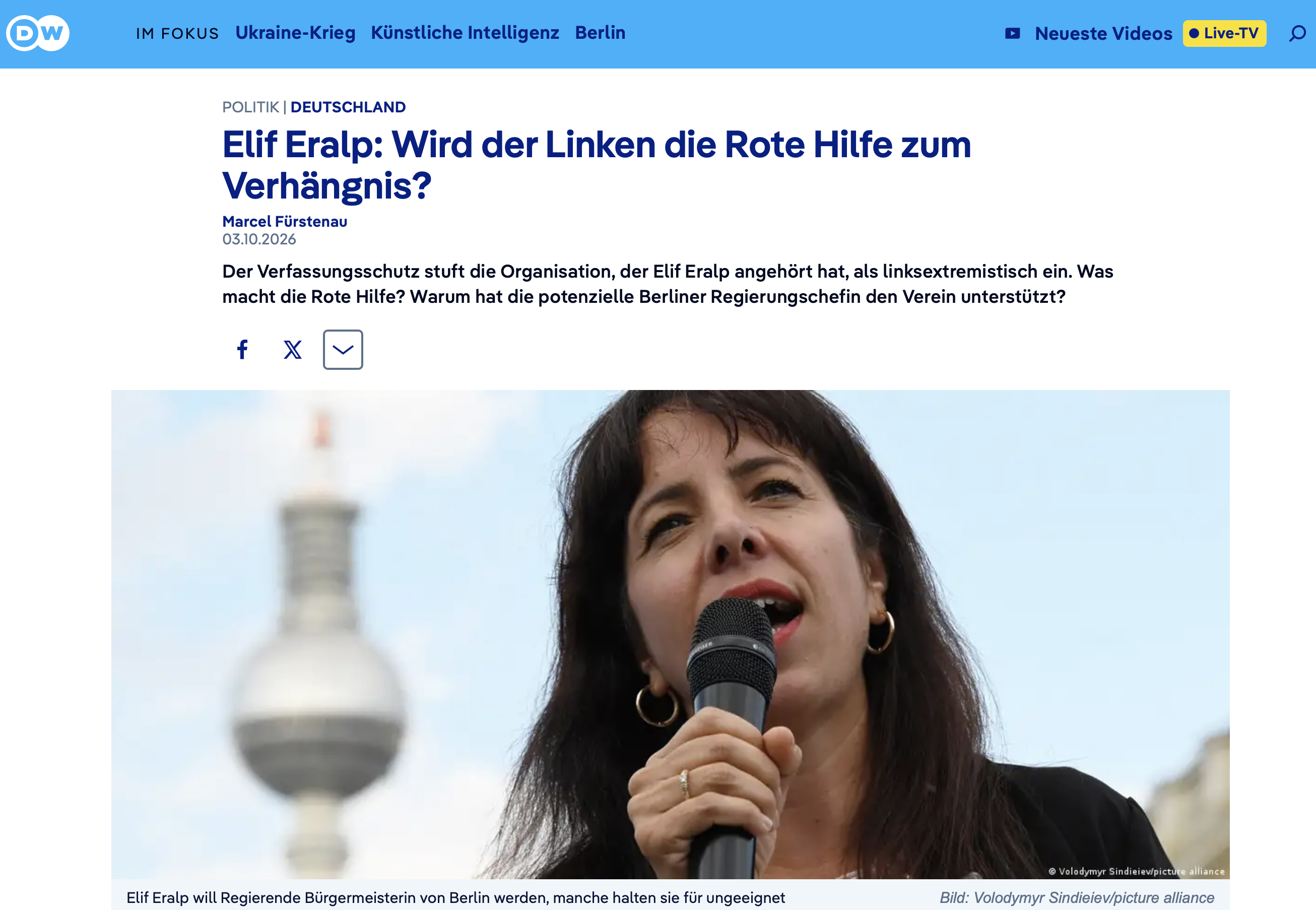
The debate in autumn 2026 over Berlin Left Party politician Elif Eralp, who had been a member of Rote Hilfe for years, showed how hysterically this obvious principle is now turned into a scandal.
The search engines supplied the dramatic framing too: far-left extremist, terrorists, outrage. You might think an association with over 21,000 members had conspired against the rule of law. Yet the supposed scandal consists merely in organising legal assistance for people dealing with the police and justice system because of political activity.
On Frühstücksfernsehen the Süddeutsche Zeitung's legal expert and journalist Ronen Steinke put it in refreshingly calm terms: Rote Hilfe was not directed ‘against the system’. It was part of that system, financing legal assistance for people who had acted from left-wing motives and whom prosecutors accused of breaking the law. Steinke is entirely right: legal defence is not an attack on the rule of law, but part of its very core.
The FAZ takes issue with Steinke's assessment. It writes that Rote Hilfe sees the state as an instrument of repression and considers itself ‘not engaged in a fight for justice, but in a political struggle’. Typical cases, it says, involve breach of the peace, trespass, criminal damage and violence against political opponents. FAZ: ‘Elif Eralp and Rote Hilfe – what the organisation stands for’
The criticism therefore runs roughly as follows: anyone calling the state ‘repressive’ is claiming that the Federal Republic is a persecuting state. Yet we are talking about criminal ‘prosecution’. And ‘repressive’ is the adjective derived from repression. Using that word is not an attack on the rule of law:
The police act preventively when averting danger. They act repressively when prosecuting crime. The prevention of danger is generally governed by the states' police laws; criminal prosecution is governed primarily by the Code of Criminal Procedure. The Federal Agency for Civic Education explains it this way too.
Criminal prosecution is coercive state action in response to a suspicion of crime. When the police investigate Reichsbürger, neo-Nazis or others on the right, that too is repressive activity. Why should the word suddenly become scandalous when the left uses it?
Of course particular investigations, judgements and police operations can and must be debated. One may also believe that political security units like to act with particular severity against the left. That does not make someone an enemy of the state. Anyone turning the term ‘repression’ into a scandal because the left uses it is pursuing a right-wing political agenda.
The fact that the state holds the monopoly on force and may act repressively is precisely what also makes that power dangerous. A healthy state governed by the rule of law is not characterised by blind trust in its authorities, but by the constant defence of their limits. The founders of modern democracy already knew this. As early as 1788, the future US President James Madison warned in the Federalist Papers (No. 48):
‘It will not be denied, that power is of an encroaching nature, and that it ought to be effectually restrained from passing the limits assigned to it.’
Legal defence is precisely that effective restraint – and is therefore indispensable.
Managers facing criminal allegations can obtain expensive legal representation. Legal expenses and D&O insurance policies cover managers' defence costs. But when people on the left help others on the left, something is supposedly wrong? If anything is scandalous here, it is the campaign waged against the left by the FAZ and other media.
Treating an organisation that gives accused persons access to legal assistance as a threat says a great deal about its critics' nervousness. Rote Hilfe helps people facing state investigations and proceedings. Calling that political is not a scandal. Showing solidarity in doing so is the whole point.
I agree with the taz: Rote Hilfe is more important than ever.
Looking for a criminal defence lawyer – with or without Rote Hilfe's support?
Get in touch