The state in its fight against drugs
Drug offence proceedings
On so-called* ‘narcotics’, the fight against them and the role of the criminal defence lawyer

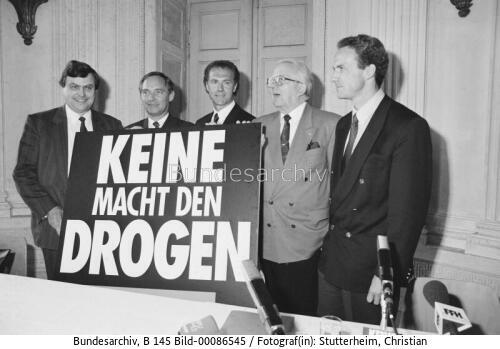
‘No power to drugs’ – that was the slogan through which, in the 1990s, politicians tried to govern against biology. Initiated by football heavyweight Karl-Heinz Rummenigge and gratefully financed by Chancellor Dr Helmut Kohl, a brisk imperative was supposed to achieve what humanity had failed to accomplish since the Stone Age: no power to drugs. A wonderfully naive undertaking. Mushrooms or poppies, coca or hemp, beer and wine – drugs have accompanied humanity since the beginning of time and will reliably outlast it. Denying molecules their power by means of a poster was therefore less addiction prevention than an embarrassing exercise in state and sporting overconfidence.
At least Kohl did not go to war over it.
Others went much further: when Richard Nixon declared the War on Drugs in 1971, rhetoric quickly turned into global militarisation. For decades, the state demonstrated that although incapable of curbing consumption, it excelled at arming half the world over white powder. What began in the US Congress as prosecution rhetoric culminated in direct interventions, gunboat diplomacy and military offensives.
Military operations in the War on Drugs
| Year | Military operation / event | Historical context & source link |
|---|---|---|
| 1971 | Declaration of the War on Drugs by US President Richard Nixon | Institutionalising the fight against drugs as a national security issue, subsequently leading to the worldwide militarisation of law enforcement. Nixon Foundation – Declaration of War on Drugs |
| 1989 | Operation Just Cause (US invasion of Panama) | The overthrow and arrest of former CIA informant and ruler Manuel Noriega under the official cover of combating drugs. U.S. Army Center of Military History |
| From 2000 | Plan Colombia | A massive US military and police aid programme worth billions in Colombia, merging the drug war with counter-insurgency against left-wing FARC guerrillas. U.S. Department of State – Archive |
| Ongoing | Militarised Caribbean and coastal patrols (Southern Command) | The permanent deployment of warships, special forces and aerial surveillance off Latin America's coasts, supposedly to combat cartels. InSight Crime – analyses of US military operations |
And sometimes the state is remarkably close to the business itself in its fight against drugs.
State involvement in drug trafficking
| Event / affair | Historical context & documentation | Source link / official reports |
|---|---|---|
| 19th century | The British Empire's Opium Wars against China (1839–1860) | The original historical example of state-enforced drug markets: to offset its trade deficit, Britain used gunboats to force China to permit the East India Company's opium sales. Encyclopædia Britannica – Opium Wars |
| 1960s–1970s | CIA, Air America and the opium trade in Laos | To finance a local mercenary army, Hmong forces under General Vang Pao, against communism in the covert shadow of the Vietnam War, US intelligence tolerated and indirectly supported the logistics of the opium and heroin trade in the Golden Triangle. CIA Studies in Intelligence – Air Operations in Laos |
| 1980s | The Iran–Contra affair & the Kerry Committee | Covert US government operations financing Nicaragua's Contra rebels while bypassing Congress. The official Senate report (Kerry Committee Report) later documented in detail how drug traffickers and smuggling networks operating around the war were protected or ignored by the authorities. |
And what criminal defence lawyer has not encountered this: a search, an arrest, seizure of drugs. The quantity originally stashed away shrinks significantly on its way to the evidence store. It makes little difference to the indictment – but others are now enjoying the material. These are not isolated cases, but police crime with a high level of under-reporting: defendants and defence lawyers do not talk about it, because it does not help the defendant, and police naturally struggle to investigate police crime.
Prominent press cases: drugs taken from police stocks and evidence stores
1. Kempten (2014–2015): the head of drug investigations and cocaine in his police locker
- The case: The head of Kempten's drug investigation unit, a senior detective chief inspector, hoarded 1.8 kilograms of high-purity cocaine in his personal locker at the criminal police station.
- Details & investigation: The case emerged when police opened his locker following a serious marital dispute at his home. The officer confessed and admitted his own long-standing cocaine addiction. The origin of the seized drugs was never conclusively established in the proceedings.
- Legal consequences: In 2015, Kempten Regional Court sentenced the former model police officer to six and a half years in prison.
- Coverage: Der Spiegel – judgement against Kempten's chief drug investigator
2. Aachen (2022): cocaine theft from the narcotics department
- The case: A 48-year-old detective chief inspector in Aachen's narcotics department stole confiscated cocaine directly from police headquarters' evidence store.
- Details & investigation: The cocaine came from an earlier raid. The investigator, himself addicted, used the substances for personal consumption.
- Legal consequences: Indictment before Aachen Local Court for misappropriation of entrusted property and unauthorised possession of narcotics; immediate suspension from duty.
- Coverage: Antenne AC – police officer alleged to have stolen seized cocaine | Bild – trial of detective chief inspector in Aachen
3. Innsbruck / Tyrol (2025–2026): theft from the LKA evidence cabinet
- The case: A 38-year-old Tyrolean detective stole 42 grams of cocaine from an evidence cabinet at the State Criminal Police Office in Innsbruck.
- Details & investigation: To obtain drugs from an earlier official operation, the officer broke the official seal on a stored container in a superior's unoccupied office. In court, he gave personal consumption as his motive.
- Legal consequences: Suspension from duty, criminal charges for burglary and breaking an official seal, and conviction before Innsbruck Regional Court.
- Coverage: Krone.at – charges against Tyrolean police officer | Krone.at – judgement in the Innsbruck trial
4. Munich police scandal (2020–2023): drug use and removal from police custody
- The case: An extensive investigation involving more than 30 Munich police officers uncovered a network of drug use, dealing and misconduct within the force.
- Details & investigation: Alongside buying cocaine and cannabis from civilian dealers, several officers were specifically accused of unlawfully removing seized drugs from police custody and obstructing prosecution while in office.
- Legal consequences: Numerous disciplinary proceedings, dismissals from service and convictions carrying fines and prison sentences.
Ultimately, the bitter irony is clear: neither the foolish ‘No power to…’ campaign nor US Navy ammunition could overcome the power of drugs – least of all state actors simultaneously fighting intoxication and covertly fuelling it in the shadows.
People have taken drugs for as long as people have existed – and even animals occasionally get intoxicated. That does not make drugs harmless: their dark side is addiction. It can destroy health, relationships and everyday life.
Consumption does not disappear simply because the state threatens it with ever harsher penalties.
*Even the term ‘narcotics’ reveals the legislature's pharmacological ignorance: many substances covered by the Narcotics Act do all sorts of things – except numb the senses. Grouping stimulants, hallucinogens and uppers under the same legal umbrella reveals one thing above all: what governs here is not scientific precision, but a desire for blanket administrative criminalisation of things not understood or assessable.
Judges, too, often struggle to assess drugs' dangers realistically. Sentencing reasons often mention that ‘hard drugs’ were involved. Any drug other than cannabis is then regarded as hard.
The classification and harmfulness of drugs
The classification and harmfulness of drugs is a complex subject. Scientists assess what makes a substance ‘dangerous’ differently, depending on the criteria used and the particular individual or societal harms considered.
One of the best-known scientific studies on this question was conducted by British neuropsychopharmacologist Prof. David Nutt and colleagues, and published in 2010 in The Lancet (Drug harms in the UK: a multicriteria decision analysis).
| Substance | Overall harm (score 0–100) | Features of the assessment |
|---|---|---|
| Alcohol | 72 | Highest overall score, particularly because of enormous societal consequences, accidents and violence. |
| Heroin | 55 | Very high individual harm: dependence, mortality and infections. |
| Crack cocaine | 54 | High potential for harm both to individuals and those around them. |
| Methamphetamine (crystal meth) | 33 | High individual physical and psychological harm. |
| Cocaine (powder) | 27 | Moderate to high harm profile in both categories. |
| Tobacco | 26 | High long-term physical harm and high addiction potential. |
| Cannabis | 20 | Intermediate harm range. |
| MDMA / Ecstasy | 9 | Comparatively low overall harm in the expert panel's assessment. |
| LSD | 7 | Very low potential for physical harm and dependence. |
| Psilocybin (mushrooms) | 6 | Lowest overall harm score in this analysis. |
Penalties have been getting harsher for decades. Criminal procedure ever more intrusive.
Chronology of escalating penalties in drug law
Here is the complete chronological overview of all major increases in severity, from the Opium Act to the present, including a separate column for the applicable sentencing range.
| Year / law | Legislative context & principal changes | Statutory sentencing range: maximum and minimum penalties |
|---|---|---|
| 1929 Opium Act | The original position: The first central narcotics statute. Its focus was commercial dealing and pharmacy transactions; no comprehensive ban on all forms of private possession. | Basic offence: Fine or imprisonment for up to 3 years. Serious case: For example, commercial activity: imprisonment for up to 5 years. |
| 1971 First Narcotics Act (BtMG) | A systematic total ban: Replacement of the Opium Act in the context of the late-1960s drug culture. Closing gaps: almost every form of involvement, including mere possession, cultivation and acquisition, becomes punishable. | Basic offence: Imprisonment for up to 3 years or a fine. Particularly serious case: Imprisonment for 1 to 10 years. |
| 1982 Recast Narcotics Act | The ‘major reform’ / heroin crisis: Introduction of section 29a BtMG, a serious criminal offence, for a quantity that is not small or supply to minors. Commercial activity becomes a standard example of aggravated offending. | Basic offence: Fine or imprisonment for up to 5 years. Particularly serious case: section 29(3): 1 to 15 years' imprisonment. Serious offence: section 29a: Minimum sentence of 1 year and up to 15 years' imprisonment. |
| 1992 Organised Crime Act / Organised Drug Crime Act | Crime in the 1990s: Creation of section 30a BtMG: gang dealing / carrying weapons. Introduction of harsh minimum sentences for importing large quantities and organised gang activity under section 30. | Aggravated offence: section 30: Minimum sentence of 2 years and up to 15 years' imprisonment. Most serious aggravated offence: section 30a: Minimum sentence of 5 years and up to 15 years' imprisonment. |
| 1998 Narcotics Act Amendment | Restrictions & precursors: Regulation of dealings in drug precursor substances and tightening of exceptions for substitution treatment. | Sentencing range: New precursor-related offences carrying sentences of up to 5 years' imprisonment. |
| 2016 New Psychoactive Substances Act (NpSG) | Criminalising groups of substances: Market shifts towards synthetic drugs, ‘legal highs’, lead to blanket prohibition of entire chemical substance groups rather than individual substances. | NpSG sentencing range: Fine or imprisonment for up to 3 years for the basic offence; in commercial or gang cases, 1 to 10 years' imprisonment. |
| 2021 Further development of criminal procedure | Tougher procedural powers: Massive expansion of digital coercive measures, including remote computer searches and interception at source, particularly for aggravated drug offences under sections 30 and 30a BtMG. | Penalties remain extreme: Procedural expansion increases prosecution pressure for offences carrying minimum sentences of 2 to 5 years. |
Has it achieved anything? No. For decades, empirical research in criminology, addiction studies and economics has been almost unanimous: steadily harsher penalties have had no reducing effect on consumption or supply in the drug market.
Ultimately, the bitter irony is clear: neither the foolish ‘No power to…’ campaign nor US Navy ammunition could overcome the power of drugs – least of all the state's ever-tightening sentencing screw. Decades of harsher drug laws have neither dried up the market nor deterred it; they have merely professionalised it, increased profit margins and driven misery underground. The crusade failed not because the law was too lenient, but because of reality – and least helpful of all were those state actors simultaneously fighting intoxication and covertly fuelling it in the shadows.
For serious players in the drug market, it is an extremely high-risk business, but one with significant profit opportunities. Those entering it know the stakes. Usually, at least: young people or drug couriers from the Netherlands, where criminal law applies different standards, are often shocked by the harshness of the penalties they face when appearing before a German court for the first time.
The system is not without a certain grotesqueness: while Western states cultivate legal arms exports as a geopolitical instrument and a profitable business worth billions, private trading in certain molecules is subjected to draconian serious criminal offences.
These state double standards – legitimised trade in weapons of war on one side, total war against intoxicants on the other – change nothing about the harsh reality before Germany's criminal courts.
Once the investigating authorities strike, ideological debates no longer help; only precise legal craftsmanship does. This is where political criticism and legal practice part ways: if you are under investigation, what matters is not the systemic question, but what I can actually do for you.
Anyone targeted by the police and prosecution often faces enormous investigative pressure: telecommunications interception, interception at source accessing messengers, limited covert listening using car bugs or directional microphones, through to residential surveillance under section 100c StPO and fake encrypted services directly connected to investigators.
People in pre-trial detention are often panicked and therefore receptive to the promises of certain loud-mouthed defence lawyers. But beware: these are sales pitches. In reality, defence options are limited – and that applies to every defence lawyer.
What I can do for you as your criminal defence lawyer
- Access to the file and scrutiny of the evidence: My very first step is to request the complete investigation file. No statement is made until we know the evidence in detail. I meticulously examine whether the prosecution's allegations rest on hard facts or mere assumptions.
- Examining the active substance quantity: expert reports: In drug law, sometimes everything depends on exact weights and active substance figures. A toxicological report often decides whether an act is treated as an ordinary offence or, as a ‘quantity that is not small’, falls directly into serious criminal offences with high minimum sentences. I question every weighing, sample and laboratory analysis, because there are many potential sources of error.
- Challenging investigative errors: exclusion of evidence: Investigating authorities often operate at the limits of what is permitted in drug cases. Whether flawed search warrants, unlawful covert listening, questionable surveillance or impermissible interview situations – when the police make procedural errors, I consistently challenge the use of the evidence.
- Establishing your actual role: Is it solely personal consumption, an occasional sale or a subordinate courier role, or are investigators wrongly trying to attribute a gang or ringleader structure to you? The exact legal classification of your involvement determines the sentencing framework.
- Setting the strategic direction: Whether discontinuance, possibly subject to conditions, negotiating a procedural agreement or fighting uncompromisingly for acquittal in court – my aim is always to obtain the best procedural outcome for you and avert prison sentences that threaten your livelihood.
What I will not do for you as your criminal defence lawyer
I do not defend ‘31ers’. Section 31 BtMG provides for reduced punishment or none at all for those who expose other drug offences: so-called assistance in solving offences. I have nothing against confessing to obtain a lighter sentence. But:
Under case law, the assistance must actually contribute to identifying or convicting other participants. The suspect – usually in pre-trial detention and keen to get out – must therefore hand a third party over to the authorities. Anyone wanting to do that must reconcile it with their conscience. And find a defence lawyer other than me.
Accompanying a client through this cooperation is out of the question for me, because it would make me an assistant to the investigating authorities. My role as a criminal defence lawyer is different.
Why section 31 BtMG is misguided as legal policy
The cooperating-witness provision in section 31 BtMG and its counterparts in section 34 KCanG and section 46b StGB is among the most controversial provisions of German criminal law. Defence lawyers, legal scholars and criminologists have criticised it heavily for decades on legal-policy and rule-of-law grounds.
1. Systematically raising sentencing ranges as ‘leverage’
Compared with other areas, such as general white-collar crime or even some violent offences, drug law already contains disproportionately high minimum sentences; see escalating penalties above.
- These high minimum sentences often bear little relation to the individual culpability involved. One might suspect that the intention was deliberately to create ‘bargaining chips’.
- The threat of a lengthy prison sentence places the accused under enormous pressure to incriminate others through ‘compelled confession or cooperation’, merely to get back down to a sentence proportionate to culpability.
2. High risk of false accusations and miscarriages of justice
When an accused person's freedom directly depends on handing over third parties, there is an enormous incentive to lie or exaggerate.
- Accused people in pre-trial detention are under extreme psychological pressure. To escape custody or halve a sentence, suppliers are invented, others' contributions exaggerated and harmless followers portrayed as ‘masterminds’.
- In practice, courts often find cooperating witnesses' statements hard to verify, particularly when witnesses possess detailed insider knowledge and merely project it onto someone innocent or less involved. A police officer is then called to verify the account who, as an advocate of the cooperating-witness scheme, tends to confirm how successful it is.
3. Violating the culpability principle and the purposes of punishment
In German criminal-law thinking, the sentence should primarily reflect the offender's individual culpability under section 46 StGB.
- Under section 31 BtMG, however, the sentence is substantially determined by post-offence conduct unrelated to the original offence.
- This produces glaring injustices: the principal offender or unscrupulous wholesaler who knows much and betrays subordinates often receives a lenient sentence. The small courier or consumer at the end of the chain, who knows no other participants and therefore has nothing to ‘offer’, faces the law's full severity.
4. Criminological inefficiency: the ‘Hydra effect’
The original idea behind section 31 BtMG was to reach the ‘big fish’ in organised drug crime. That rarely works in practice:
- Structures are often less hierarchical than investigators imagine.
- Real masterminds shield themselves behind multiple levels of hierarchy so lower levels do not even know them.
- Even if a supplier is convicted, high profit margins mean new players immediately fill the gap in the black market. The provision mainly generates numerous cases against small dealers, but rarely dismantles structures permanently.
5. Burdening the search for truth and encouraging a ‘deal’ mentality
Section 31 BtMG encourages an opaque culture of arrangements between prosecution, defence and court. The trial often becomes little more than approval of outcomes negotiated in advance, while the presumption of innocence for third parties incriminated by the cooperating witness is effectively hollowed out because investigators give the ‘cooperative’ witness considerable credit in advance.
Further reading
Klaus Bernsmann: Cooperating-witness provisions in current law, in: JuristenZeitung (JZ) 1988, pp. 539–545. A classic, much-cited contribution. A few years after section 31 BtMG's introduction, Bernsmann concluded that the ‘much-invoked masterminds’ of drug trafficking had not yet been ‘struck with fear and terror’; instead, the provision created a ‘half-hearted collaborator’ who incriminated others from cover, not infrequently without justification.
Further reading: the cooperating informant under section 31 BtMG
Andreas Hoyer: The figure of the cooperating witness, in: JuristenZeitung (JZ) 1994, pp. 233 et seq. Examines the erosion of rule-of-law principles and constitutional concerns about sentence reductions for mere usefulness in investigations.
Andreas Mischkewitz: The state witness protection programme in Germany
German Federal Bar (BRAK) & German Bar Association (DAV): In various statements, such as BRAK Statement No. 23/2006 or DAV statements on section 46b StGB / section 31 BtMG, the associations regularly highlight the danger of false incrimination under detention pressure, the violation of the culpability principle under section 46 StGB, and the erosion of the presumption of innocence.
Caught with drugs?
Search?
Arrest?
 +49 172 7224081